
THE OLD CRANBERRY LADIES GARDEN CLUB
by Bill Cusano
June 1 - July 10, 2026 Virtual Book Tour
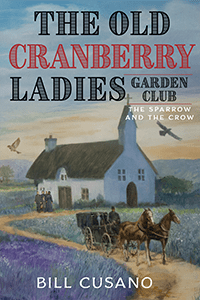
THE SPARROW AND THE CROW
The last time the crows circled the old farmhouse, her husband Chester was found dead and the town named her a murderess. Thirty years later, the truth she buried with him is stirring again, the country is splitting in two, and the family she fought so hard to hold together is being pulled apart by a war that hasn't yet been declared.
Her grandson Auggie wants to fight for the Union. His mother, born to a Virginia plantation family, will do anything to drag him south instead. Millie — the rector's daughter with golden hair and a satchel full of letters — waits at home for a boy who may never come back. And in the chapel behind the lilacs, Elcira and the women of her garden club continue the work no one is supposed to know about: sheltering freedom seekers as slave catchers tighten their grip on the Connecticut coast.
Then a telegram arrives. And another. And the war everyone said would never come has come for the Cranberry's all at once.
Perfect for readers of Kristin Hannah, Marie Benedict, Paulette Jiles, and Charles Frazier's Cold Mountain — a story about what families inherit, what they hide, and what they're willing to risk when the country they believed in begins to come apart.
Book Details:
Genre: Cozy Mystery, Historical Mystery
Published by: 4610 Publishing
Series: The Old Cranberry Ladies Garden Club
Links: Amazon | Kindle | Barnes & Noble | BookShop.org | Goodreads | BookBub
Read an excerpt:
Elcira
Cranberry Farm, Cranberry, CT 1861
The crows are back. Who are they here for this time?
They’re more intelligent than most other birds. That’s what people who know birds have said. Are they really? If so, what do they know? Elcira remembers seeing two crows perched on the roof of the old farmhouse back in ‘33, a year after the murder. She felt it might be an omen, a sign that more trouble would be headed her way. She was right. Being labeled the widow murderess by the town hasn’t made it easy to do business with those who admired her husband, Chester. He would turn sixty this year. How long can the truth stay buried? Does it wither like a leaf or decay like a body? Or does it wait patiently for everyone to stop looking for it so it can make its appearance like a ghost in the shadows, holding a candle to the darkness?
Some things anchor themselves in place, and they never leave. The birds know that. They can sense what’s coming, and Elcira fears they may be right.
The evenings are getting warmer, although a frost still sneaks in while the world sleeps and paints a crystal sheen on the tiny buds on her lilacs and on the first shoots struggling to break through the soil. This is an active world where the ears awaken before the eyes.
And the birds are the ones to call everyone to life. There is a rooster on the farm now. He likes to be the first to rouse the family to life. The men in the lodges pride themselves on being out the door before Doodle, as they call him, announces the day. Sometimes, though, he fools them and blasts his voice at the moon. Even the crows find that disturbing. They flutter and take flight, descending on the chapel bell tower to warn Doodle that there can be louder sounds across the fields and stables.
Evening is Elcira’s time. When the children were young, it was their time. Stories and games would fill the hours before bedtime, and by then, she would be too tired to do this, sit under the oak tree, and anticipate the return of the fragrances that remind her of each child, her seven varieties of lilacs. The first will not bloom for a few more months, but it will start the explosion of color and joy. That one, the violet one, was planted when Felix was born, thirty-eight years ago. It’s all his now: the lilacs, the pond, the stables, and the fields. He would inherit it all anyway, so why not let him make the decisions and command the respect of the men and women who keep the farm and its legacy alive? She almost lost it all when the town turned against her after the murder. They blamed her for that. Chester was the one they knew and loved. Not her. There are still many who haven’t changed their views.
“Mom?” Felix calls out from the house beyond the lilacs.
“In the garden,” she says. It is not much, but it is enough for the garden club ladies to tend to when they meet. The rose bushes have overrun much of the slope from the lilacs down to the wide patch of grassy dirt that leads to the cabin. Penelope, Colonel Townsend’s daughter, planted them when the colonel lived in the cottage Felix calls the carriage house.
She leans against the tree to stand, pulling the blanket from the ground to wrap around her just as Felix appears, followed by Auggie.
“You look worried,” she says. “What’s happened now?” “Grandma,” says Auggie. “Colonel Townsend and his men are getting ready for war. He says that the militias in New York, Massachusetts and Pennsylvania are stockpiling weapons and training their troops.”
“So, this Confederacy is a real threat?” she asks.
“I want to join the militia, Grandma,” says Auggie. He pushes his hair from his face, making him look even more like a child than before. Felix takes Auggie by the arm. “I can’t let you. I need you here.
Your mom needs you. Grandma needs you.”
Elcira stands before the boy, who is already taller than she is. “Why do you want to join?”
“There’s going to be a war, and I don’t want to miss out.”
“Miss out?” Elcira hugs him and kisses him on the neck. She whispers in his ear, “Don’t be in a hurry, child. The war will wait.”
“No, it won’t. I’m going to be seventeen on my next birthday. This may be the only chance to fight.”
“Henry has joined Townsend and his men,” says Felix. “The Army will accept Negroes?” she asks.
“Mom, he’s almost white. Times are changing.” “Fast enough for you to let Auggie go?”
“We’re talking about Henry. He’s a grown man. Sometimes, you act like we’re still children.”
“You will always be my children, Felix.”
“You can’t blame Henry for wanting to live free and vote. You know what it was like for him growing up.” Felix removes his hat and hits Auggie with it. “Come on, let’s all go back in the house. We need a family meeting. Your mother needs to hear this.”
Elcira watches her boy walk with his son up the hill to the house. How many times did she do the same thing, calling a family meeting with all the children on the floor in a circle, while Deborah nursed Henry? Later, when he was old enough to crawl, he would be in the center of the circle, and Agnes would serve the apple cider. They would all have an opinion to share. Then, they would vote.
“I can’t imagine that the colonel will be fighting. His men are Connecticut militia. They defend us here, not in the South.” Felix makes his case.
“It’s Lincoln’s fault this is happening,” says Felix’s wife, pouring apple cider into her glass. “He claims to be for states’ rights, letting states decide on slavery, but he refuses to allow slavery in new territo-ries. He should spend some time in the South and see what life is like on a plantation.” She sits beside Felix at the table.
“He hasn’t even been sworn in yet. Maybe he can avoid a war,” says Felix. “But if war breaks out, we will have to defend our home, not go off to fight in South Carolina or Mississippi. Five more states have joined them this past month.”
Elcira sips her cider while fixing her eyes on her grandson. The thought of Auggie fighting against his mother’s family in Virginia is frightening.
“I need to visit my parents,” says Lorraine.
“I can’t let you go,” says Felix. “It’s too dangerous.”
“I’ll go by train. It will be faster than by coach,” she says. “Auggie can go with me.”
“No,” says Felix. “I forbid it.”
“I want him to meet his grandparents, aunts, uncles, and cousins, and see what it’s like there. Virginia hasn’t seceded. It will be fine.” Lorraine reaches over to kiss her son on the cheek.
“You want to teach him to turn his back on his country and disre-spect his President?” asks Felix.
“I want him to see there are two sides to this argument.” Lorraine turns away. “Besides, he hasn’t taken office yet. He may not wind up our president.”
“What are you saying?”
Elcira, sitting on the other side of Auggie, places her hand on his. “How do you feel about that?”
“I don’t know,” he says. “How long would we be gone?”
“You’re not really considering this,” says Felix, turning to Lorraine. Lorraine sips her cider and puts the glass down on the table.
“I’ll go with you, Mom,” says Julie, hugging her mother around the neck. “I’d love to meet Grammy and Pappy.”
“Me, too,” says C.J. “Come on, Auggie. It’ll be fun. We’ve never been to a real plantation.”
“I can’t have my whole family go,” says Felix.
“We’ll go, and Auggie can stay with you,” says Lorraine.
Felix leans close to her. “I wish you had talked to me about this before mentioning it to the children.”
“I thought that is why we have family meetings, so everyone has a say,” she says. “Besides, Virginia is still part of the Union, and the politicians will sort all this out. Just you wait and see. Maybe we will have two separate countries. No need to worry.”
Lorraine places her hand on Auggie’s hand, and Elcira pulls hers away. “Who knows if we’ll be able to do this again?”
“Lorraine,” says Felix. “I have a bad feeling about this.” “It’s my family, Felix.”
“We’re your family,” he says. Felix pushes his chair away from the table and stands. “I can’t allow it.” He walks to the door.
Lorraine looks at Elcira and shakes her head. “Was he always like this?”
Elcira smiles and opens her arms. “Come, all of you, and give me a hug. I love you so much.”
The children run to her and hug her. Felix, standing in the doorway, bathed in moonlight, remains silent.
Auggie
oodle warbles his call to rise. It’s finally morning. Auggie tosses his jacket on the buckboard seat and wipes his brow with the bandana Uncle Wally, the youngest of the Cranberry
boys, gave him when he was only one year old. Later, after graduating from West Point as an officer, he told Auggie he had never washed it. So, Auggie has never washed it, either. At times, especially on hot days, it smells like feet. He would love to serve under Second Lieutenant Wallace Cranberry when they go to war against the Confederacy. He is certain war will come. He didn’t always have premonitions, but at times, images have come to him in dreams or while staring at the clouds in the sky, like now. They look white and fluffy, but one to the south has a dark center. Uncle Wally hasn’t visited in a while, a sign that something may be brewing. Auggie can almost taste it, like milk that has gone sour.
Living with Grandma is great, especially in the summer, when aunts and uncles come to visit. The cousins don’t all own horses, so they love it when their uncle Felix shows them how to rope and jump. But racing is what everyone loves to do. Auggie imagines galloping into battle on Lightning, his father’s horse. He’s not the original Lightning, the horse his father got when he was ten years old. Dad still rides him sometimes. Auggie calls him Old Lightning.
“You headin’ into town this mornin’?” asks Jones. He is using an awl to punch holes in a leather strap. “I’m almost done repairing these billets.”
“I’m taking the buckboard, so I won’t be needing a saddle.” Jones rights himself, casting a shadow on the sixteen-year-old. Auggie stands close to him and marks his height against Jones’
chest with his hand. “Almost,” he says.
Jones chuckles and grabs Auggie’s hand, pulling it up to his own head. “You’ve got a ways to go yet, mister.”
“I figure I won’t be growing much taller than this,” he says, climbing onto the buckboard. “Ma wants me to get myself a trunk for traveling.”
“Where will you be goin’?”
“Richmond,” he says. “To see my relatives on their plantation.”
Jones puts his hands on his hips. The muscles in his arms make his linen shirt lose all its wrinkles.
“Sorry,” says Auggie.
“What for?” asks Jones. He steps closer and leans on the seat of the buckboard so he can talk to Auggie face-to-face. “You know I used to be on one of those plantations, right?”
“You were? Were you a slave? I thought you were born free like Miss Townsend.”
“Deborah?” Jones smiles, showing he still has most of his teeth, which are yellow from tobacco. “I’ve always loved that woman.”
“Really?” Auggie grabs the reins to hold the horses steady. “Why didn’t you marry her?”
“Let me tell you somethin’,” he says, leaning close enough for Auggie to smell the tobacco on his breath. “When you’re sweet on someone, you have to let them know. Don’t go holdin’ it in and waitin’ for the right time cause somethin’ always comes up.”
“But what if she doesn’t feel the same way?” Auggie has someone in particular in mind.
“Better to know the truth than to keep the unknown inside.” “Is that what you did? Keep it inside?”
“You sweet on someone?” he asks, ignoring the question. “Who is it?”
“Millie,” he says.
“The preacher’s daughter? Wooeee!”
“You see why I have a problem? The preacher and Pa don’t like each other.”
Jones shakes his head. “That goes way back. You sure know how to pick ‘em. She’s a pretty one, I’ll admit that. Looks like her mama.”
“So, should I let her know?”
Jones taps him on the shoulder and points toward the house. Mom is headed this way, dressed like she’s about to receive dignitaries from afar. She always dresses up, even if she’s going nowhere. She says it’s the right proper way for a lady to look. Back home on the plantation where she was born and raised, one wouldn’t let the sun shine on them without having something bright and beautiful to see.
“August Cranberry, why are you lollygagging around? You ought’a been and come back by now.”
“I’m just going now, Ma,” he says, giving the horses a flick of the reins.
“Now, you wait here, young man. Since you haven’t left yet, you might as well take your siblings with you.”
“What?” Auggie’s plan to find Millie is now ruined.
Jones laughs. “See what delayin’ can do? Back to work.” He walks away whistling.
“We both can’t go with him, Mom,” says Julie, fastening the ribbon on her bonnet. “We’ll be too tight on that seat.”
“It wouldn’t be a problem if you weren’t-” “Watch it,” says Lorraine.
“I was just going to say her skirt is so big; it’ll look like we’re all wearing them.”
“It’s a short trip into town,” says Lorraine. “You can manage.” “What are you concerned about, Auggie?” asks C.J. “Afraid someone might see you wearing a skirt?” Julie laughs and climbs up onto the seat.
“For that,” says Auggie, “you sit in the back, little brother.”
“I’m not little. I’m almost as tall as you, and besides, we are only a year apart.”
“Now, remember, we need three large trunks for the trip.” Lorraine kisses C.J. before he climbs aboard.
“How large?” asks Auggie.
“Large enough for you to put your clothes in it. You should be able to get three across.”
“Then where will I sit?” asks C.J..
“You can sit on Julie’s lap,” says Auggie. Julie punches him in the arm.
“You’re acting like children,” says Lorraine. “We are children,” says C.J..
“Speak for yourself,” says Auggie. “I’m a man.”
Julie and C.J. look at each other and erupt into laughter. As they pull away, Julie turns to Auggie. “So, who is it?” “Who is what?” asks C.J..
“Never mind,” says Auggie.
“I know who it is,” says Julie. She flips her curls back and forth, her nose in the air. “It’s that highfalutin one.”
“She’s not highfalutin.”
“What’s that mean?” asks C.J. “Is it a teacher?”
“No, dunderhead,” says Julie. “Hoity toity. Nose in the air type.” “She’s not like that,” says Auggie.
“You know she’s our cousin, right?”
“Oh,” says C.J. “I know who you mean. You like Silly Millie?” “Stop it, both of you.” Auggie clicks the reins, and the horses
respond with a jolt, sending C.J. rolling in the back and Julie holding onto the back of the seat.
“Slow down,” Julie scolds. “You’re going to kill us.” “Then we won’t need as many trunks, will we?” he says.
They continue to tease each other the entire way into town, but Auggie’s thoughts are on Millie. He has to find a way to see her before they leave for Virginia.
“Hey, Auggie, keep your eyes on the road,” yells Julie. Auggie tugs at the reins, and the horses slow down to a trot.
“He’s got it bad, Julie,” says C.J.. “Maybe you should stay home, Auggie.”
Auggie wonders if it would be better if he did. He could be with Millie before enlisting. He needs to see her. Maybe it would be better if the whole family went. Millie, too? But Dad won’t come. Why?
Lorraine
he wraps herself in the shawl she crocheted for her mom. It is much warmer back home on the plantation, but there are always times when a shawl will do just right for that rock on the porch with a hot tea at night. Perhaps she will add lace at one end so
it can be worn around the neck.
“Cold?” asks Elcira, exiting the house onto the back porch. She has a blanket wrapped around her, secured by a large hatpin.
“It’s always cold here,” says Lorraine.
“It used to be much colder.” Elcira holds her cup with both hands and sits on one of the rockers. “The old farmhouse wasn’t much protection from the weather, especially in the winter and when the storms came.”
Lorraine sets up her writing implements on the wooden table beside her and opens her folio of papers to compose a letter. She could have spread out her papers on the table near the fire, but she wanted privacy. This is her house, and she has no place to be alone in it.
“I suppose you will let your mom know you’re coming to visit.” Lorraine fakes a smile.
“So, what brought your family to Virginia?” Elcira sips her tea. “I seem to recall that you were all from Pennsylvania. Is that not correct?”
“You’re talking about my father’s family. My family is from the South.” Lorraine is her mother’s daughter, through and through. It was her mother’s family that built the plantation and turned it into a major tobacco producer in Virginia. It was her father who brought his business sense and political contacts to the table, negotiating deals to take that business beyond its roots and fences.
Elcira sips some more tea and buries her head in a newspaper she has folded lengthwise to hold with one hand. “I see. If it wasn’t for the Mason-Dixon Line, we would never know where the North ends and the South begins, would we?”
Lorraine dips her quill pen in the ink bottle and starts writing, trying to ignore Elcira’s attack. It is an attack. With each passing minute, her thoughts drift from the paper and float back to Elcira. So focused on her is she that the sound of each sip aggravates her.
Elcira finishes her tea and stands. “Don’t get too warm, now,” she says. “Oh, I’ve asked Deborah to come by. Please keep an eye out for her. She should be along soon. She has some news about Henry.”
Lorraine grumbles. Her pen slips, spreading ink across the paper. “Damn it to hell,” she says.
She crumples the paper and starts again, this time resting the folio and paper on the table to steady her hand.
Dearest Father, I know how hard it has been for you without me, and I feel the same, but I have good news. The children and I will be coming to visit. They are excited about meeting you and Mother, and I cannot wait to introduce them to our beautiful family. I will be arriving in Richmond by rail on Sunday, the 17th of March, six days from now.
August, Julie, and Chester James will be with me. Please have one of the coloreds come pick us up in the coach. We are scheduled to arrive in the morning, but we have many changes along the way, so we could be later than that. Until I see you, love,
Lorie
As she folds the letter, she realizes she should have had the children post it in town. She will have to ask Elcira to send someone or, better yet, have Felix ask her.
She seals the ink bottle, wipes the quill with the crumpled paper, and neatly piles everything on the folio on the table. Of all the things she learned from Mother, being neat and clean is paramount, next to godliness, as they say. And a place for everything, she would say. It was a while before she realized the rest of that expression is “and everything in its place.”
Was that really something Ben Franklin said? He is given far too much credit for quotes these days. She glances at a newspaper folded on the chair Elcira vacated. This new president is going to be trouble. Why can’t he just let the states govern themselves? Maybe the South should be a separate country. She will take her family to meet their real family, their roots, and maybe they’ll want to stay.
The sun has lifted itself above the lilacs in the east, warming her a bit, but not enough to shed the shawl. It, too, gets folded and set aside neatly. A handsome young man on a black Morgan is approaching the road at a trot, sending splashes of mud to each side, making the roadway even more treacherous for a woman to maneuver. There is something odd about his appearance. His face is round with a squared-off jaw, like Felix’s, but his nose is a little flatter than most. From a distance, he could be Felix’s younger brother.
“Elcira?” Lorraine stands at the doorway and yells in.
“You must be Felix’s wife,” says the man, tipping his hat. His hair is wiry, not at all like Felix’s.
“I’m Lorraine Peters Cranberry, from Virginia,” she says, sounding intentionally formal.
“Well, it’s a pleasure to meet you, ma’am,” he says, copying her accent.
How disrespectful.
“Henry!” shouts Elcira, running past Lorraine to greet him. ”Get down here and give me a hug.”
“This is Deborah’s child?” asks Lorraine.
“Where is Deborah?” asks Elcira. She kisses Henry on the cheek. Lorraine turns her head.
“Mom stopped in at the Townsend house. She wanted to see the new room for carriages and horses at her old home.”
“That was your brother who did that.” “Brother?” asks Lorraine.
“It’s a joke from our childhood,” says Henry. “Where is Felix?” “He’s out and about,” says Elcira. “He’s getting more like his
father every day.”
“Do you have business with my husband?” asks Lorraine. She holds her head high when she speaks to Henry.
“I’ll wait for Mom to get here, but I want to give him the good news.”
“We heard that you’ve signed on with Colonel Townsend’s militia.” says Elcira, her eyes on Lorraine.
“That’s not the news I’m talking about.”
“Certainly the militia isn’t that desperate for recruits,” says Lorraine.
“Desperate?” Henry looks at Elcira and smiles. “I believe the correct response to that might be something like, Bless your heart.”
Lorraine grabs her folio and papers and stands. She spots Felix coming up the road, followed by another horse.
Henry steps onto the porch, and Lorraine backs away from him. He’s got more nerve than a bad tooth, that one. Back home, his kind know their place. Lorraine stomps her foot and turns to send a death stare at Elcira.
Henry steps around Lorraine to greet his mom as she dismounts from her horse. Deborah gives Elcira a hug and a kiss. “I’ve missed you.”
“I’ve missed you, too.”
Lorraine pivots on her heel, walks through the open doors, and drops her folio on the round pedestal table.
“So, what’s the big news?” asks Felix, tying his horse to the post and doing the same for Deborah’s.
“Our boy here is engaged,” says Deborah.
Elcira runs into Henry’s arms and hugs him. “Felix, come. Hug your brother.”
Lorraine closes the double doors and runs up the stairs to her bedroom.
“How appalling,” she says to the empty room.
Mabel
Cranberry, CT
Sitting under the porch roof, Mabel Crossan chews on the end of her imported Cuban cigar, a real treat, much smoother than the old Connecticut Shade wrappers of Rocky Patel or Brick
House. She leans on her ebony cane with a silver handle, using it to rock back and forth while she talks with passersby or an occasional visitor, such as Judge Richards.
“Cuban?” he asks as he slowly makes his way toward her, favoring his right leg.
“Still bothering you?” she asks. She pulls another cigar from the pocket of her jacket and hands it to him, along with a match.
He reaches into the small pocket of his overcoat for his silver cigar cutter and snips the end. “There’s a bit of a chill in the air today. I thought it was warming up.”
She waits for him to sit and light his cigar.
“Pleasant taste, right?” she asks. She coughs and spits. “Have you let the doctor look you over?” he asks.
“I haven’t been to the doctor since Doc Williams passed. I’m not sure about this new one. He’s got his wife working with him.”
“You got something against women? Or is it just the Cranberrys that you have a problem with?” He lets out a cloud of blue smoke. “That’s water under the bridge,” she says.
“Stagnant water? Or something fresh, good for fishing?”
Anabel sticks her head out of the store’s open doorway and looks around. “Have you seen Emily?” she asks Mabel.
“You lost her again?” Mabel laughs and coughs.
“I need to take a break, and she’s been gone a while.” “You go,” says Mabel. “I’ll handle it if someone comes.”
“It’s been quiet.” She ducks back in. Mabel can hear her scramble across the floor to the back door.
“I hear some of them city folk have public toilets. Maybe we can get one here.”
“By the Anchor Tavern, most likely,” she says. “That’s where most of the relieving is done.”
He chuckles and draws in the smoke again, letting it slip out of his mouth into the air.
“Maybe if I smoked the way you do, I wouldn’t have this cough of mine,” she says.
“I know why you don’t want to see Doc Cranberry.”
“They used to call him Tubby. When he was a child, he always had something in his mouth. I guess it could be worse. In Stamford, the doctor is a Negro.”
“If I had only had my way,” he says, pointing over his shoulder to the docks and steamships. “They all would have been sent back where they came from.”
“You need to be careful what you say, Judge. We’re surrounded by abolitionists.”
“Lincoln lovers, I call them,” he says.
“Oh, horse dung,” she says. “Look who’s coming this way.” She points to a buckboard pulled by two horses.
“That curly-haired one driving is one of the grandkids of our good friend Chester. Remember him?” she asks.
“Of course I do. That good-for-nothing constable couldn’t solve Chester’s murder the whole time he was on the job. Finally shot himself when his wife died. We’ve gone through three since then, and the latest one is the worst of the lot.”
“You don’t think he’ll bring anyone to justice, Judge?”
“Not the justice I’d like to see. Besides, these constables are always too busy running side businesses to do a decent job. More opportunities for the widow on the hill. Are you forgetting who took over Constable Tucker’s oyster farming business?”
“She seems to profit off the deaths of those around her, doesn’t she?” Mabel pushes down on her cane. “Now, let’s see what her brood needs today.”
“Have you gone back to extending credit to her?”
“She doesn’t need credit anymore, not since her firstborn married up. These are Lorraine’s children, and she sent them alone. With the threat of war, I may have to mark up my prices.”
Judge Richards releases a blue cloud and shakes his head. “I’m thinking you might want to have an ally in the enemy camp if you know what I mean.”
“You have a point, there, Judge.”
She turns to greet the arriving children and escorts them into the store.
“Now, let me see if I remember,” she says. “You are August, right?” “Auggie, ma’am.”
“That’s what we all call him,” says Julie.
“And you must be Julia, or do you prefer Julie?”
Julie nods. She drifts over to the shelves of women’s shoes, but a dress on a stand captures her attention.
“And the last time I saw you, young man, you were being pushed around in one of those prams by Agnes?”
“Yes, I’m C.J., ma’am.”
“Ah, Chester’s namesake, I believe.” “Did you know my grandpa?”
“Everyone in town knew Chester Cranberry,” she says, shifting her cigar from right to left in her mouth. “So, what can I interest you in today?”
“We need three traveling trunks,” says Auggie. “All the same size, I presume?”
Anabel returns and joins her mother.
“Maybe these two young men could accompany you upstairs to the attic and bring down three large wooden trunks.”
“Not too large,” says Julie. “Mom wants the three to fit side-by-side on our buckboard.”
Julie runs her hands down the front of her dress to keep it from billowing in the breeze from the waterfront behind the store.
Seagulls announce that the tide is high and ripe with fish.
Mabel taps her cane near Julie and leans on it, bringing herself close enough to whisper. “See anything you like?”
“What is holding this skirt up? Are there many petticoats under it?”
She walks around the dress and lifts the skirt to reveal hoops. “Oh, it’s much lighter than petticoats. There are steel hoops that
let the skirt flow outward. And the colors this year are much more exciting.”
“I wouldn’t know where to wear such a dress.”
Her brothers and Anabel return with the trunks, and the boys carry them to the buckboard. When they come back in, Mabel addresses them all.
“Before you leave for your trip, have your mother come in and see me. She can settle the payment then, and we can talk.”
“But my mother gave me money to give you for the trunks,” says Auggie, holding a purse.
“You tell her to come in. I would love to talk to her and see what else we can do for your trip.”
“Thank you,” says Auggie. “Come, Julie.”
Julie touches the satin on the hoop skirt before joining the boys on the buckboard. As they leave, Anabel turns to her mom. “What was all that about?”
“Did you see how Julie looked at the dress?” asks Mable. “I’m sure that Southern belle mother of hers would love to present her only daughter to the wealthiest and most influential young men around here.”
“You’re going to play matchmaker?”
“I wouldn’t think of such a thing,” she says. “I want to sell all the latest Paris fashions.”
“Well, I want my daughters in those fashions first, Mother.” “And they will be.”
“What are you two plotting in here?” asks Judge Richards, standing in the doorway. “I thought you didn’t want to have anything to do with that family.”
“Times have changed, Judge,” says Mabel. “And they’re going to change a hell of a lot more.”
Lorraine
Cranberry Farm
Boys are easier than girls. Actually, as she thinks it over, they are both bad, except for C.J., who is the easiest of the lot. And Julie can be madder’n a wet hen at times. Lorraine is sorry she
agreed to take all three children to Richmond. One more conniption fit and she will leave without them.
“Mom,” says Julie, with a whine that adds syllables to the word as it escapes her mouth. “I can’t fit my dresses in this trunk.”
“Why didn’t you think of that when you bought it?” “You said-”
“I said to pick out your trunks and see that they fit three across in the buckboard, right?”
“But, Mom,” she replays the last whine.
“Mom,” cries C.J. at the door to Julie’s room. “Auggie filled up his trunk, and now he is putting his things in mine.”
“Auggie!”
“Just teasing,” he yells back. “Thank you, Mom,” says C.J..
“Much obliged,” says Lorraine, longing to get back to her child-hood home, to be among the sound of mind and body.
She works on Julie’s dress problem for longer than she desires and then decides to give up. “We’re going back to the store.”
“We are?” Julie is suddenly excited.
“What’s cooking with you, Miss Water-Under-Both-Shoulders?” “What does that mean?”
“It means you have a hidden agenda. Why do you want to go back to the store?”
“To get a larger trunk?” Julie turns to look at her clothes overflowing the sides of the trunk.
“Unpack and carry it downstairs. I’ll meet you out front with the buckboard.”
For most of the trip back to town, Julie remains silent. What is she thinking? She’s never this quiet. She doesn’t look worried about the trip.
“Sweetheart,” says Lorraine. “I’ve mapped out our trip, and we’ll have to change trains several times.”
Julie whips her curls around and bites her lips.
“But the Lord has been good to us because we have first-class tickets all the way from New York to Baltimore.”
“Is that far?” she asks.
“It could take some time, maybe two days from when we leave Stamford to get to Baltimore, and then another day to Richmond.”
The trunk in the back of the buckboard rumbles as they ride over a stretch of bumpy road.
“Are there cousins my age?”
“Honey, you’ve got more cousins than you can count on your fingers and toes.”
Julie smiles. “I won’t be the youngest girl, will I?”
“No need to fret over that. My brother may be busy organizing the militia in support of the Confederacy, but he sure left a brood back home.”
Julie rolls her skirt in her fingers, signaling that she is working on a problem only she knows. Lorraine lets her be. Julie is not one to offer up an honest answer when prodded. That is a trait they share.
“Is that how you met Dad?” “What?”
“Did you snag him?”
“Well, almost,” says Lorraine. “Your Uncle Wally and my brother roomed together at West Point, so I got to meet Wally before I met your dad.”
“Oh? Then why didn’t you marry him?” Lorraine laughs.
“Didn’t you like Uncle Wally?” Julie’s eyes are wide open now. “Your Uncle Wally is a real looker, if you know what I mean. I
could have snagged him, but your dad was persistent. Must have been my accent.”
“Or your beauty?”
“You do know how to charm the skin off a snake. You’re going to be a real catch for somebody someday.”
As they ride into town, musicians and dancers parade down the street to attract everyone’s attention. A large crowd gathers at the fairgrounds.
“Looks like we may have a bit of a delay.” “Can we go and watch?” asks Julie.
“You saw them setting up when you came here earlier, didn’t you?
That’s why you made a fuss about the trunk.”
Julie pulls a clipping from the local paper out of her purse. “Maybe.”
“You little dickens,” says Lorraine. “I had better keep you on a short leash.”
“Can we stop for a little while? Please?” Julie leans over the side of the buckboard, craning her neck to see the juggler tossing balls in the air as he walks.
“I should just turn around and take you home.” The parade passes on both sides of her buggy, making it difficult to negotiate a turn. “All right, but just for a little bit. We have to get ready for our trip tomorrow.”
Julie jumps down and runs off.
“Julie, get back here!”
“Funnel cakes. I’ll get you one.”
Lorraine turns at the blacksmith’s shop and parks, handing the man a coin to watch over it. Lorraine dodges people and parasols in the crowd, along with two fiddle players and their jabbing bows.
“Julie!” She loses sight of her and panics.
“Something wrong, ma’am?” The man in a bowler hat and frock coat taps his hat with his silver-tipped cane. “Emerson,” he says. “Mark Emerson. I own the steamship where these folks perform.”
“I lost sight of my daughter, Julie. She went to get funnel cakes and disappeared.”
“Well, let’s see if we can find her.” He towers above many of the people by at least a head. He looks like a carnival barker, but with a significant paunch..
“Can you see the funnel cake stand?”
“You’re not from around here, are you?” He stops looking for Julie and turns his attention to Lorraine.
“My daughter, please.”
“If I thought she was in danger, I would rush to her side, but I believe she may be the one surrounded by those young men watching the juggler.”
“How do you know it’s her? I didn’t tell you what she looks like.” Lorraine starts to panic. She pushes her way through the crowd and heads toward the juggler.
“Julie!”
Julie turns, and Lorraine runs to her. White powdered sugar coats Julie’s mouth and chin.
“I got one for you, too.” Julie hands her a funnel cake.
“I’m taking you home,” she says, grabbing her wrist. “My heart near busted clean outta my chest, child. How am I gonna keep you safe all the way to Richmond?”
“I just wanted to see the juggler. He had more balls in the air than I have curls on my head.”
“Don’t go making up stories. You best not mistake silence for forgiveness. I’m not done being mad at you yet.” “What about the trunk?”
“Make it work.”
“But, we need to go to the store to pay for the trunks, and I want to show you a dress that I’m sure you would want me to wear when we see Grandma and Grandpa,” says Julie, batting her eyelashes and showing her dimples.
“You little minx,” says Lorraine, climbing up onto the buggy. “You’ve been stretchin’ my patience like a clothesline in a windstorm. Time to reel it in.”
Lorraine guides the buggy away from the store and back toward the farm, avoiding the crowd at the fairgrounds.
“But, Mother!” Julie crosses her arms. “I -” “Don’t say it. You will regret it if you do.” Julie mumbles the words she couldn’t swallow.
***
Excerpt from THE SPARROW AND THE CROW by Bill Cusano. Copyright 2026 by Bill Cusano. Reproduced with permission from Bill Cusano. All rights reserved.
Author Bio:

Bill Cusano is an author, a retired deacon in the Episcopal Church and a believer that it is the process rather than the outcomes that matter most in our lives. Retired from the corporate world and an eight-year stint running a non-profit feeding program, Bill attacks every project as a ministry, giving it his full commitment. Needing to readjust to life after losing the love of his life to leukemia in April of 2024, Bill returned to writing full-time, resulting in The Old Cranberry Ladies Garden Club series, the motivation and inspiration for which came from his wife’s voracious appetite for reading historical fiction. While this is Bill’s debut novel, he has always been a writer, publishing short stories and poems early on, and then beginning a daily spiritual blog in 2008. You can follow Bill’s Reflections From The Garden Bench along with other writings on his Substack account.
Catch Up With Bill Cusano:
BillCusano.com
Bill's Substack
Amazon Author Profile
Goodreads - @billcusano
Instagram - @billcusano
X - @CusanoBill
Facebook - @bill.cusano
Tour Participants:
Click through the other tour stops for can’t-miss reviews, insider interviews, exclusive guest posts, and more chances to win!Click here to view the Tour Schedule
When Crows Circle… It’s Time to Enter to Win
This giveaway is hosted by Partners in Crime Tours for Bill Cusano. See the widget for entry terms and conditions. Void where prohibited.
The Old Cranberry Ladies Garden Club by Bill Cusano | Surprise Gift Box w/ Gift CardCan't see the giveaway? Click Here!
No comments:
Post a Comment